
Buffalo Construction Accident Lawyer
Trusted construction accident lawyers with over 50 years of experience.
The consequences of a construction site injury in Buffalo extend well beyond the physical damage. Medical expenses begin accumulating on the day of the accident, income ceases while you recover, and serious doubt about your ability to return to the same line of work compounds the financial pressure. During that period, the insurance carrier and the general contractor are already preparing their account of how the accident occurred.
Hurwitz, Whitcher & Molloy has represented injured construction workers across Western New York for more than 50 years. Our Buffalo, NY construction accident lawyer can determine whether you have a workers’ compensation claim, a third-party personal injury claim, or both. Contact us to discuss your situation.
Construction Accident Lawyer Buffalo, NY
Construction sites rank among the most hazardous workplaces in the United States. BLS fatal injury data recorded 1,032 deaths among construction and extraction workers nationally in 2024. But the danger is only half the story. What makes these cases legally distinct is the number of parties who may bear responsibility. The property owner. The general contractor. Subcontractors. Equipment manufacturers. Each one may have contributed to the conditions that caused your injury — and each one may owe you something different.
New York compounds that complexity with some of the strongest worker protection statutes in the country. Owners and contractors have obligations that reach past ordinary negligence. A construction accident attorney in Buffalo, NY knows how to apply those statutes and pursue every available path to recovery.
Types of Construction Accident Cases We Handle in Buffalo
Our firm represents construction workers throughout Buffalo, NY, and Erie County who have been hurt on the job. Which legal theories apply, and which parties can be held accountable, depend on the type of accident.
- Scaffold accidents. Collapses. Unsecured platforms. Missing guardrails. Scaffold injuries are among the most devastating on any construction site. New York Labor Law § 240, the Scaffold Law, holds property owners and general contractors absolutely liable when they fail to furnish adequate elevation-related safety devices. No other state has a statute this protective. The worker’s own negligence is not a defense.
- Falls from heights. Steel erection, roofing, bridge work: anything performed above ground level carries the risk of a life-changing fall. OSHA’s Focus Four ranks as the leading killer in construction. A 15-foot fall can fracture a spine. A 30-foot fall can be fatal. The height matters less than most people think.
- Struck-by-object incidents. A wrench dropped from scaffolding. A load swung by a crane. Unsecured sheet metal caught by the wind. These incidents happen in seconds, and the injuries such as skull fractures, crushed hands, internal bleeding are often permanent.
- Caught-in or -between accidents. Heavy machinery that closes on a limb. A trench wall that gives way. A worker pinned between a vehicle and a fixed object. Excavation cave-ins alone kill dozens of workers every year, and nearly all are preventable.
- Electrocution. Contact with overhead power lines, exposed wiring, or improperly grounded equipment. Outcomes range from severe burns and cardiac arrest to death. Electrical injuries also cause nerve damage that may not become apparent for weeks.
- Equipment and machinery failures. When a crane cable snaps, a hoist drops its load, or a power tool shatters, the cause is usually defective design or deferred maintenance. These claims can involve product liability actions against the manufacturer alongside negligence claims against the site owner or contractor.
- Occupational diseases. Some construction injuries develop over the years. Chronic back damage from daily lifting. Hearing loss from prolonged noise exposure. Mesothelioma from asbestos. New York’s workers’ compensation system covers these conditions, but the filing deadlines and proof requirements differ from standard accident claims.
- Slip and fall accidents. Wet concrete. Debris on a walkway. An unmarked floor opening. Not every construction fall involves scaffolding or a roof. Ground-level falls cause torn ligaments, herniated discs, and concussions that can keep a worker out for months.
Why Choose Hurwitz, Whitcher & Molloy for Construction Accidents in Buffalo, NY?
Decades Representing Injured Construction Workers
Construction injuries are at the core of what Hurwitz, Whitcher & Molloy has done since Melvyn L. Hurwitz founded the firm. He has spent his entire career representing injured workers before the New York State Workers’ Compensation Board and remains a member of the New York State Bar Association, the Workplace Injury Litigation Group, and the Injured Workers’ Bar Association.
Michael J. Whitcher, with the firm since 1992, focuses on workers’ compensation and personal injury. He graduated magna cum laude from the University at Buffalo, earned his J.D. from UB Law School, and handles the third-party lawsuits that arise when a construction injury involves negligence by a party other than the direct employer.
The firm has helped injured workers recover millions of dollars through both workers’ compensation and civil litigation. Construction injuries frequently involve both tracks. A worker hurt in a scaffold collapse, for instance, may collect workers’ comp benefits from the employer’s carrier while simultaneously suing the property owner under Labor Law § 240. Our firm handles both. For cases where a broader personal injury claim in Buffalo is warranted, we can assist you.
Construction Accident Infographic
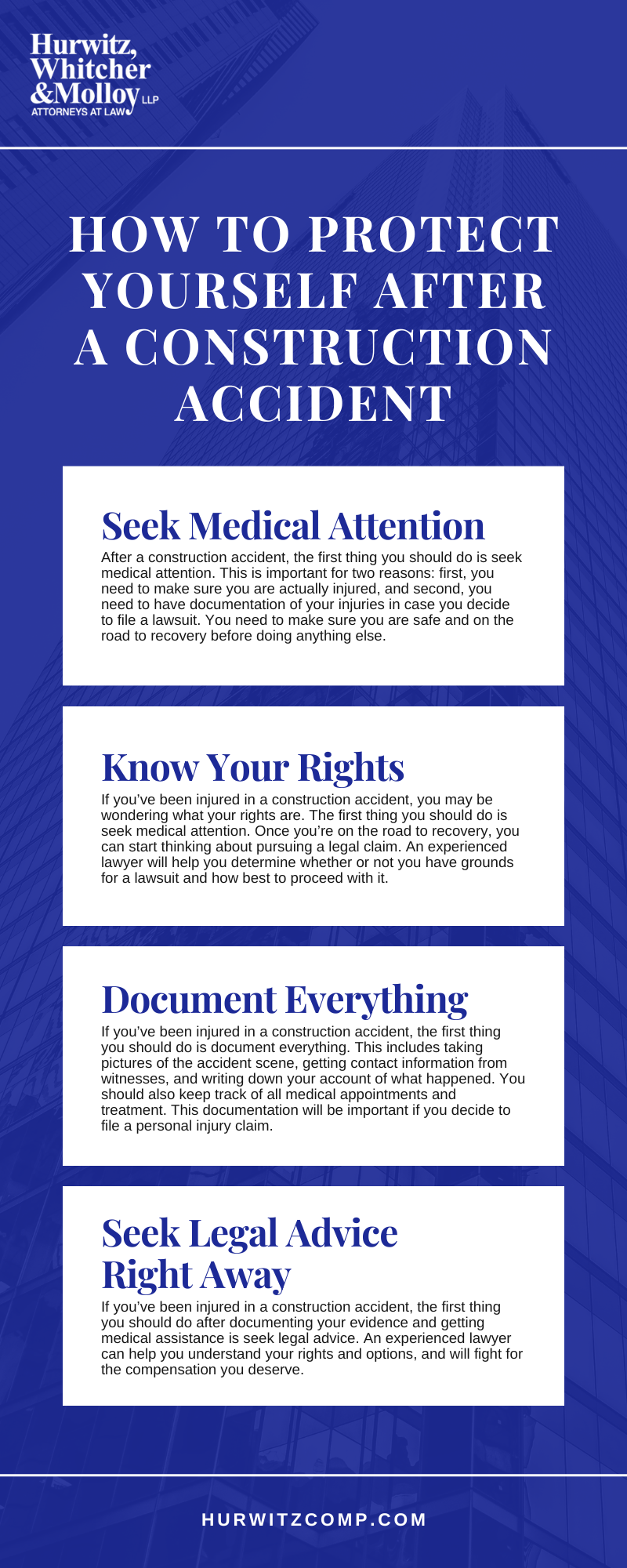
Construction Accident Case Overview
Damages, Liability, and Compensation for Construction Accident Cases
Construction accident claims in New York can move through two separate legal tracks. Most injured workers are entitled to pursue both.
The first is workers’ compensation. It is a no-fault system. You do not need to prove anyone was negligent. If you were injured in the course of your employment, you are generally entitled to medical benefits and partial wage replacement. The Workers’ Compensation Board administers these claims.
The second is a third-party personal injury lawsuit. This applies when someone other than your direct employer bears responsibility. A property owner who knew about a hazard and did nothing. A general contractor who ignored safety requirements. A manufacturer whose equipment failed. You can sue those parties for full damages, including pain and suffering, which workers’ comp does not cover.
New York’s Labor Law § 240 is what makes the third-party track so significant in construction cases. It requires owners and contractors to provide proper scaffolding, hoists, ladders, and protective devices for elevation-related work. If they don’t, and a gravity-related injury results, liability is absolute. The injured worker’s own conduct is irrelevant to the liability determination. Labor Law § 241(6) goes further, imposing a duty to comply with specific Industrial Code regulations governing construction, excavation, and demolition. A documented violation of any applicable regulation can establish the defendant’s liability as a matter of law.
Third-party damages in construction cases can include past and future medical costs, lost earnings, reduced earning capacity, pain and suffering, and loss of enjoyment of life. New York does not cap non-economic damages in most of these cases.
Important Aspects in Your Construction Accident Case
Construction accident claims carry procedural requirements that can weaken or eliminate your case if missed.
- Notify your employer within 30 days. Failing to do so puts your workers’ compensation benefits at risk.
- File a C-3 Employee Claim with the Workers’ Compensation Board within two years of the accident. This deadline is firm.
- Identify every party with potential liability. A single construction site can involve a property owner, a general contractor, three or four subcontractors, and multiple equipment suppliers. Missing one of them means leaving compensation on the table.
- Document the scene immediately. Photographs, equipment serial numbers, witness names. Construction sites change fast — debris gets cleared, scaffolding comes down, daily logs get filed away. Waiting costs you evidence.
- Do not give recorded statements to insurance adjusters without your attorney. Adjusters do this every day. You do not. What you say will be used to minimize both your workers’ comp benefits and any third-party claim.
Construction Accident Case Timeline
These cases tend to run longer than standard injury claims because of the number of parties involved and the parallel legal tracks.
- Day 1–30: Medical treatment, employer notification, scene documentation. File the C-3 with the WCB as soon as possible.
- Weeks 2–8: The workers’ comp carrier evaluates the claim. Meanwhile, your attorney begins the third-party investigation — site ownership, contractor relationships, code compliance history.
- Months 2–6: If the carrier controverts the workers’ comp claim, hearings begin. The personal injury investigation deepens with depositions, subpoenas for inspection records, and document requests.
- Months 6–24+: Discovery and motion practice on the third-party lawsuit. Workers’ comp hearings proceed on a separate schedule. Settlement discussions may happen on both tracks at once.
- Resolution: Workers’ comp cases end through a Section 32 agreement or a final WCB decision. Third-party claims resolve by settlement or jury verdict.
What to Bring to Your Construction Accident Consultation
Bring whatever you have. Even partial documentation is enough to begin.
- A written account of the accident — when it happened, where on the site, what you were doing, and what went wrong
- Photos of the scene, the equipment involved, and your injuries
- The names of your employer, the general contractor, and the property owner, if you know it
- Medical records, imaging, and treatment notes from any provider who has seen you
- Pay stubs or wage records covering the 52 weeks before the injury
- Any letters, emails, or forms you have received from the insurance carrier, the WCB, or your employer
We will review everything, explain whether your case supports a workers’ comp claim, a third-party lawsuit, or both, and outline the next steps. If you already have an attorney and want a second opinion, bring whatever filings exist from that relationship.
New York Legal Resources for Construction Accidents
These resources cover the statutes and regulations most relevant to construction injury claims in New York.
- Labor Law § 240 — Scaffold Law — the absolute liability statute governing gravity-related construction injuries involving scaffolds, ladders, hoists, and similar protective devices.
- Labor Law § 241 — Construction Safety — New York’s statutory requirements for worker safety during construction, demolition, and excavation.
- OSHA Construction Focus Four — federal training materials covering the four leading causes of construction fatalities: falls, struck-by incidents, caught-in/between hazards, and electrocution.
- OSHA Worker Rights — federal resource on workplace safety standards and the right to report hazardous conditions without retaliation.
- Bureau of Labor Statistics — national data on workplace injuries, fatalities, and illness rates broken down by industry.
- New York State Bar Association — attorney search tools and legal process information for New York State.
New York requires all employers to carry workers’ compensation insurance. Injured workers must report within 30 days and file a C-3 claim within two years. Beyond workers’ comp, Labor Law §§ 240 and 241 give construction workers the ability to pursue third-party claims against property owners and general contractors, claims that can produce compensation well beyond what the workers’ comp system provides.
Reach Out to Hurwitz, Whitcher & Molloy to Schedule a Consultation
A construction accident claim in Buffalo, NY is rarely straightforward. Multiple defendants, two parallel legal tracks, statutory protections that most injury cases lack. Hurwitz, Whitcher & Molloy has spent five decades handling these cases. We know the workers’ comp system, and we know how to build a third-party case that holds up before a jury. Contact our office to schedule a consultation.